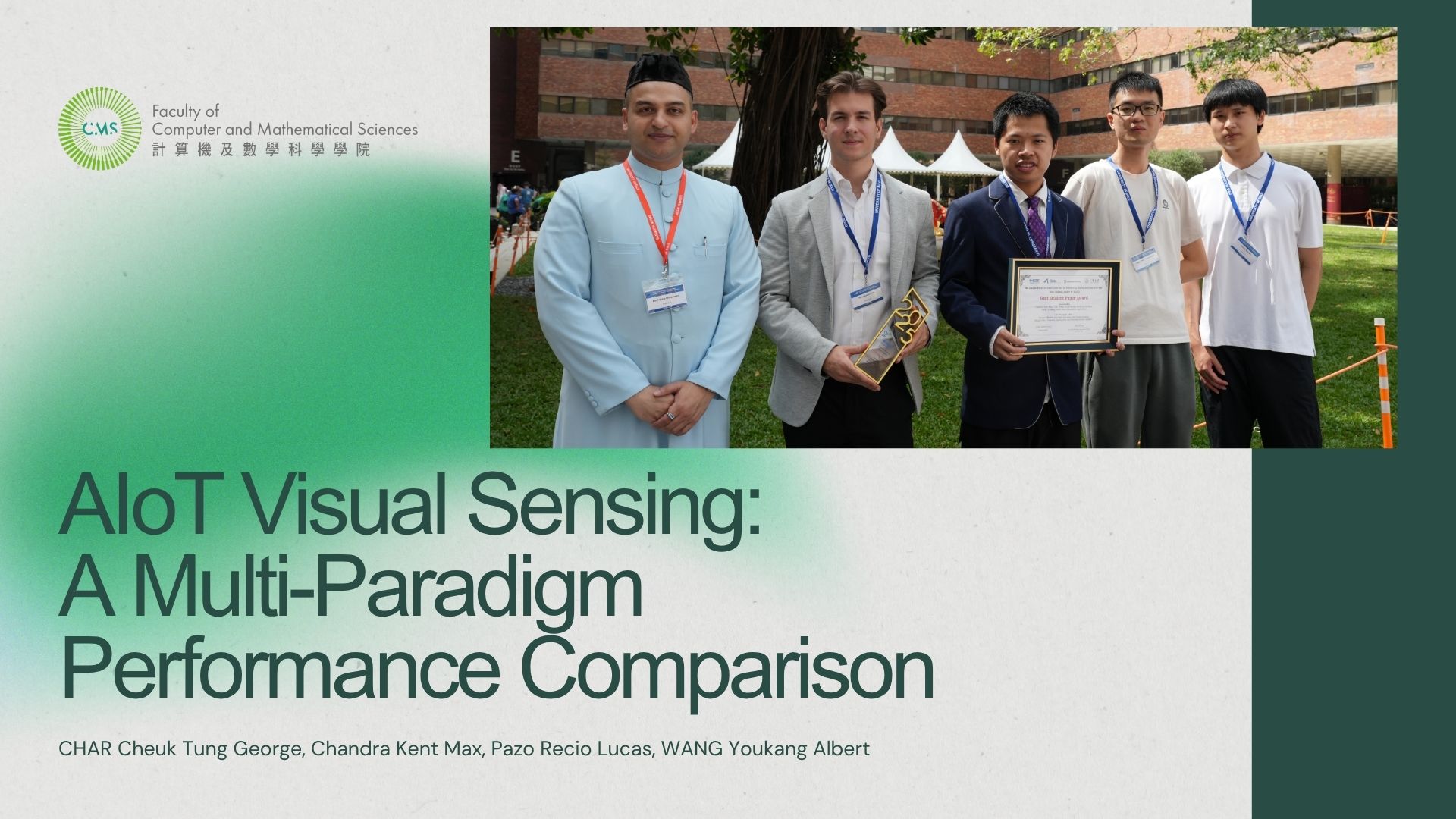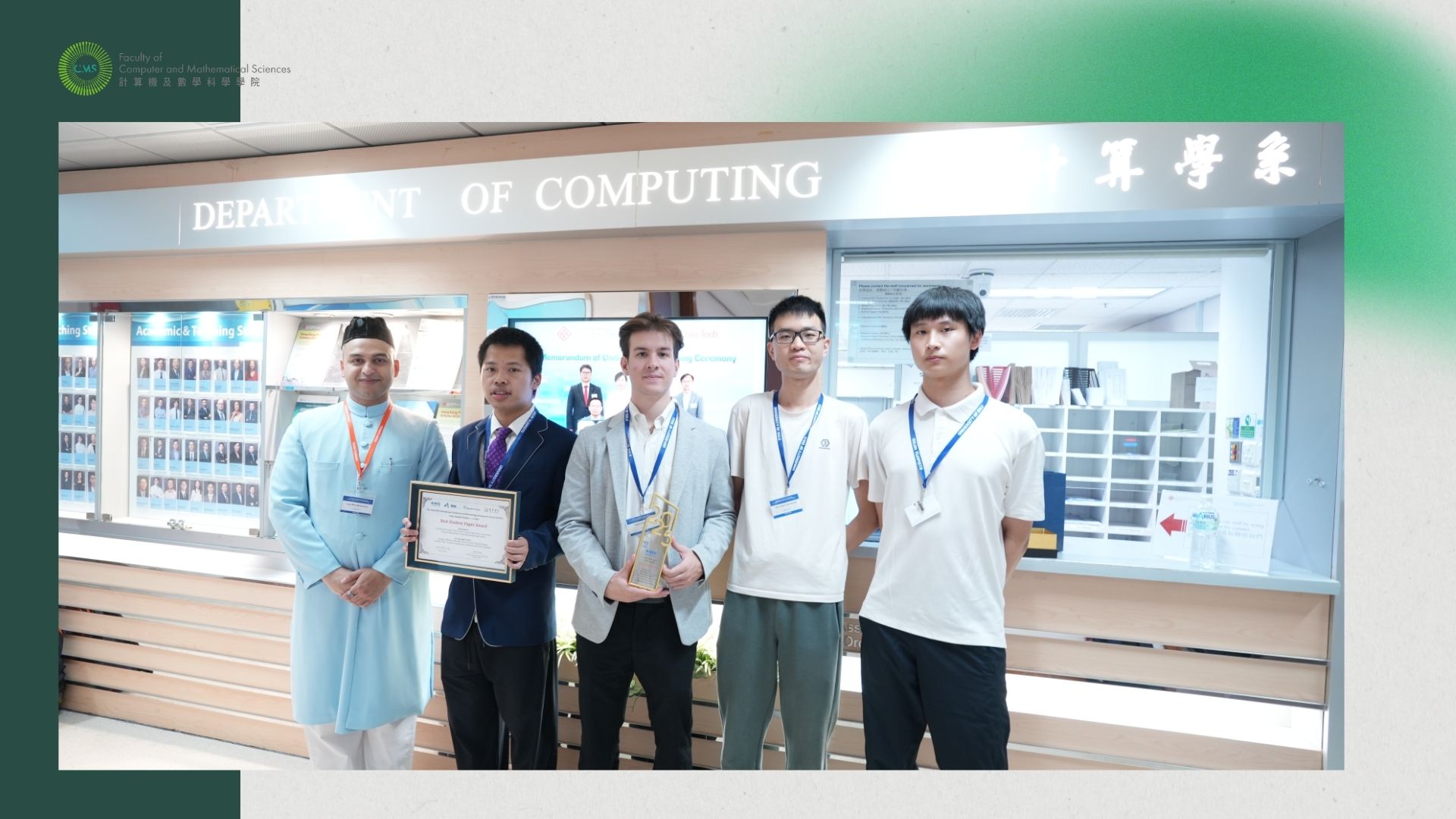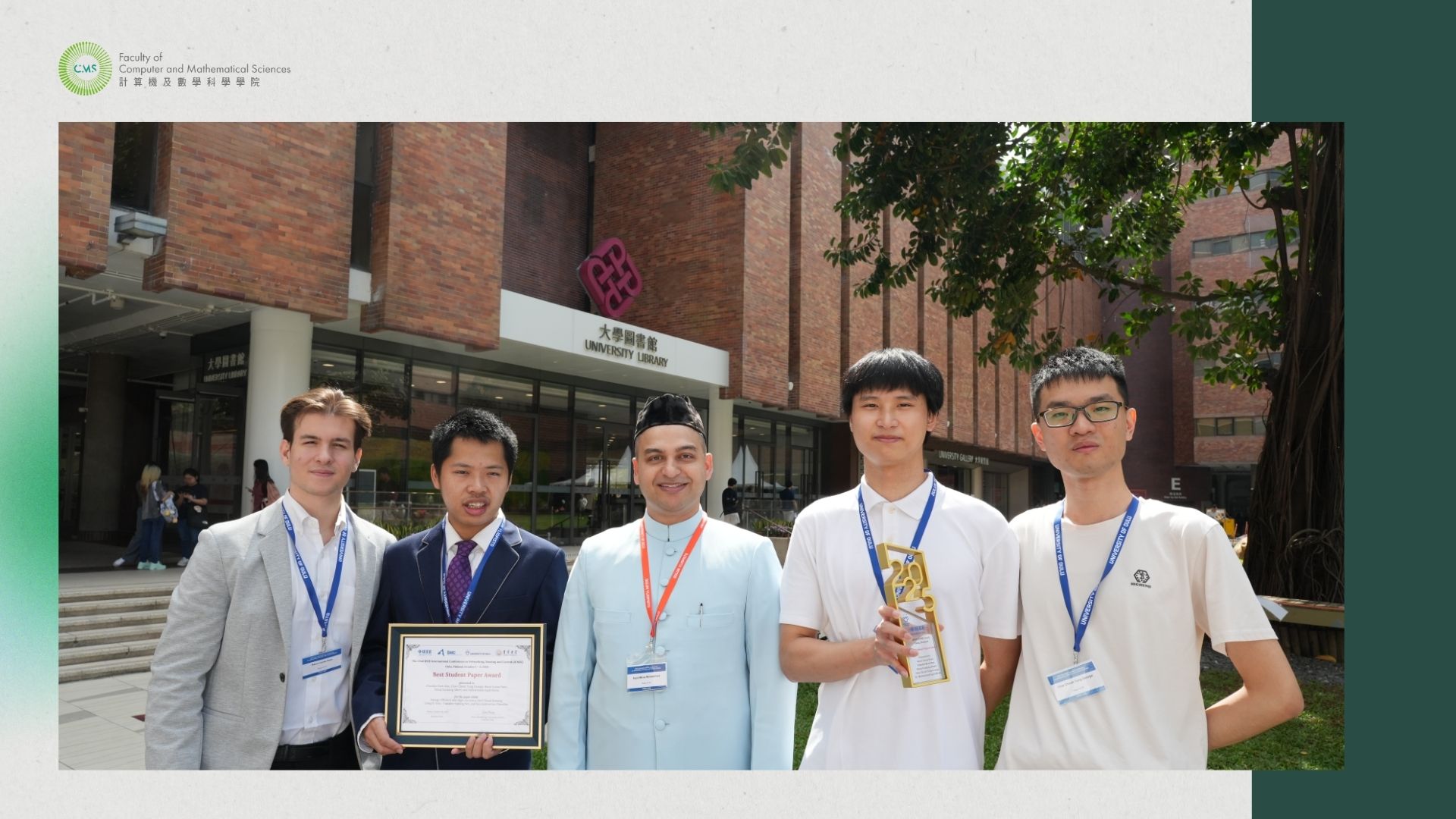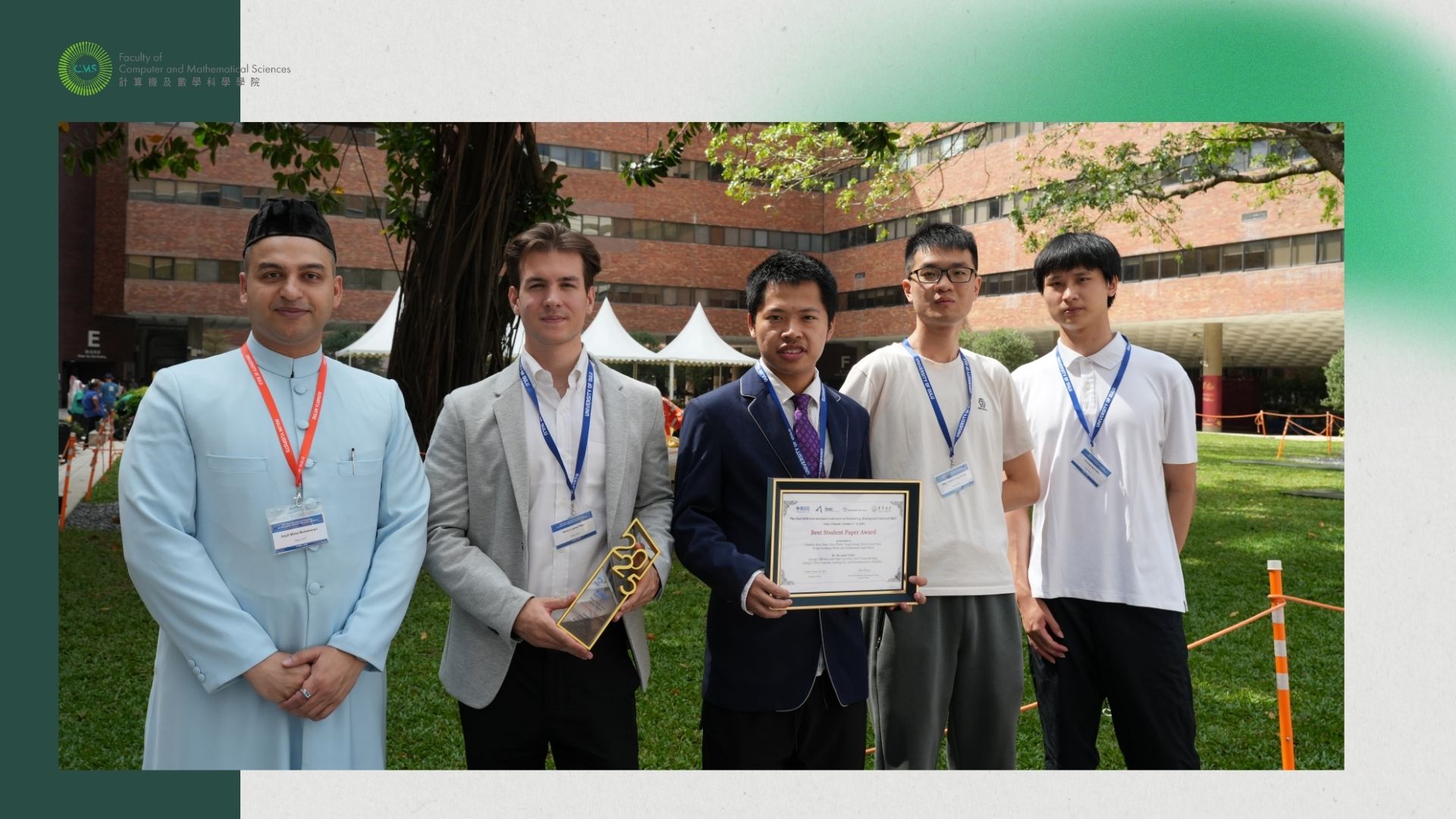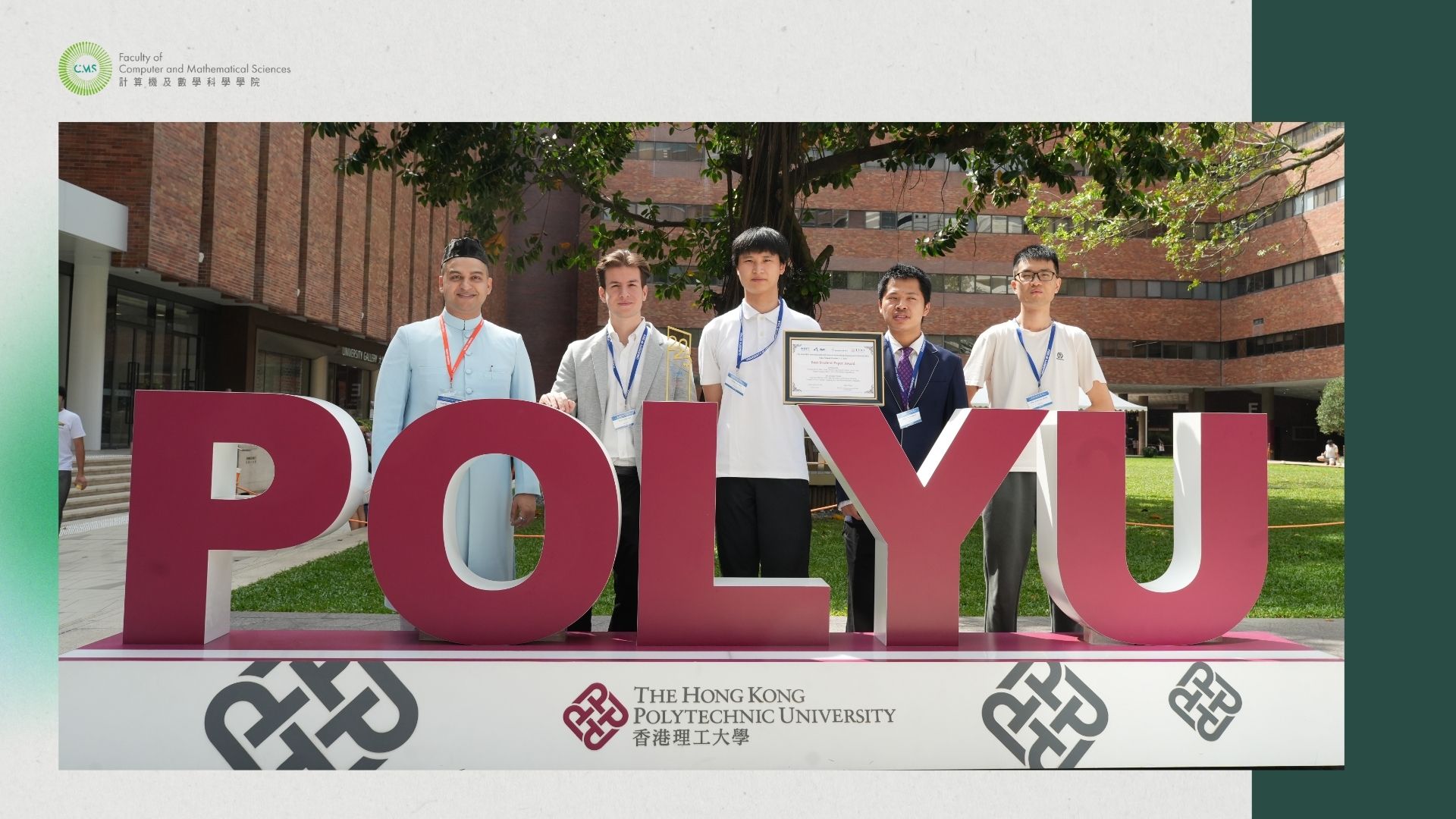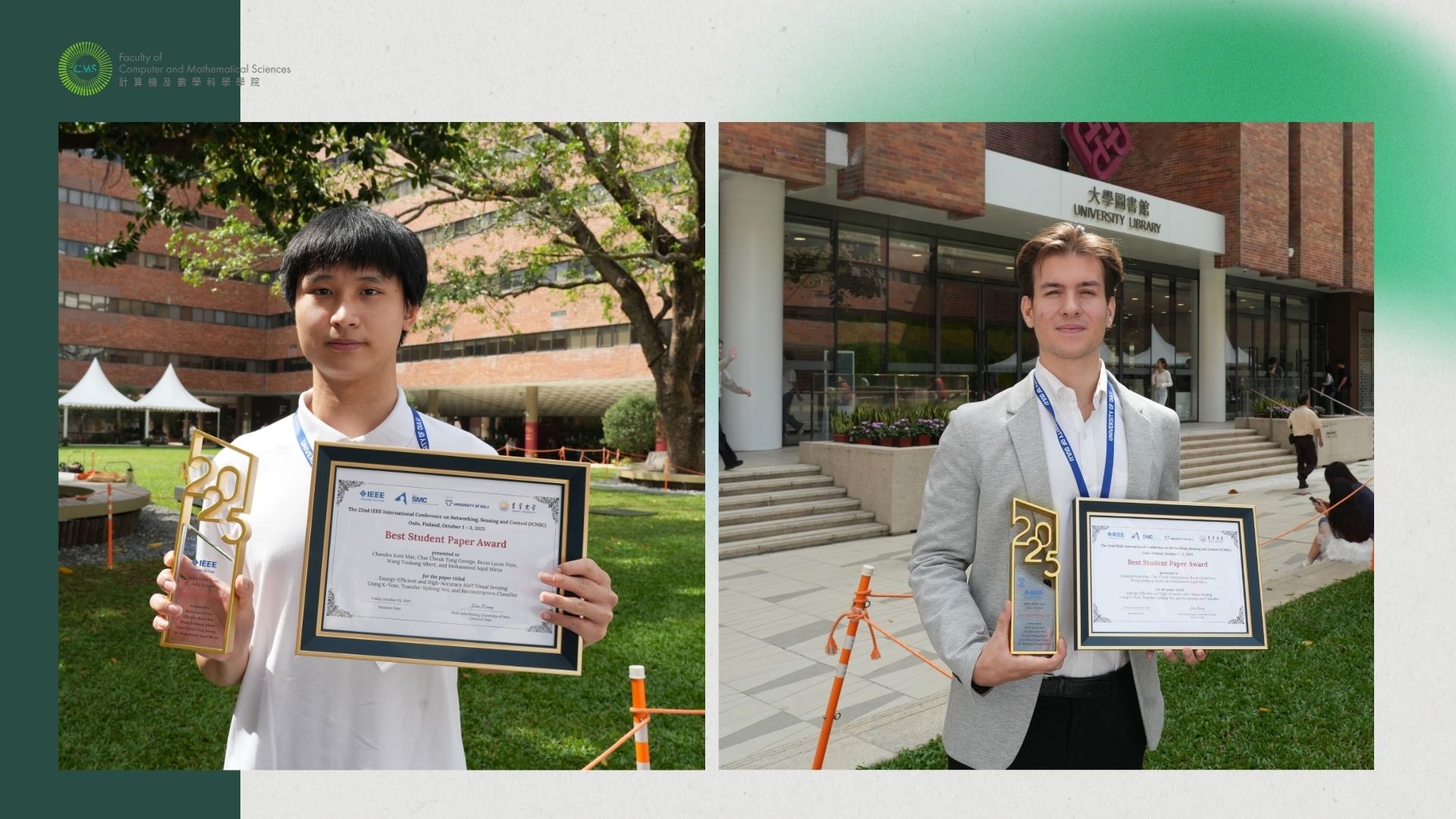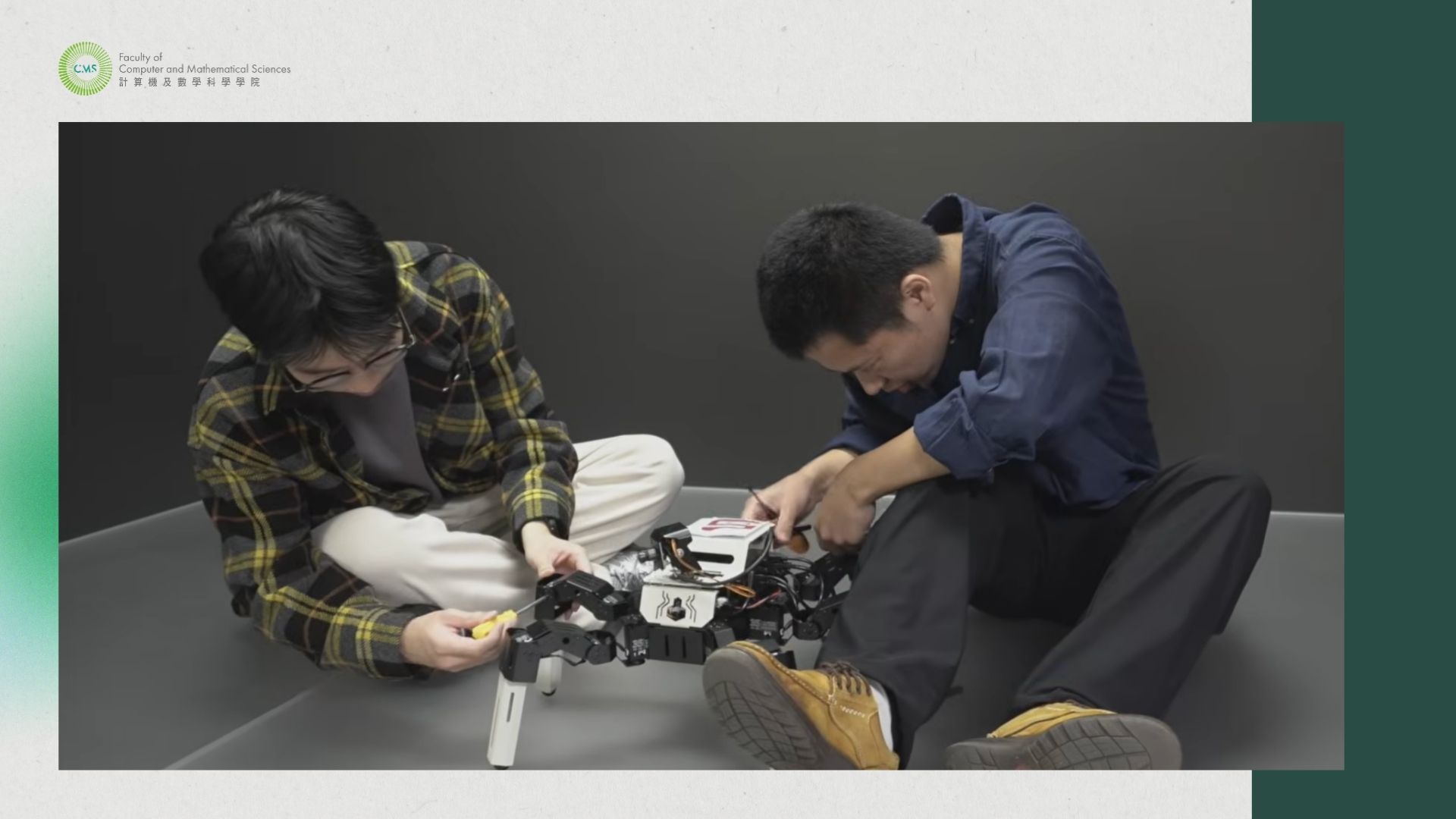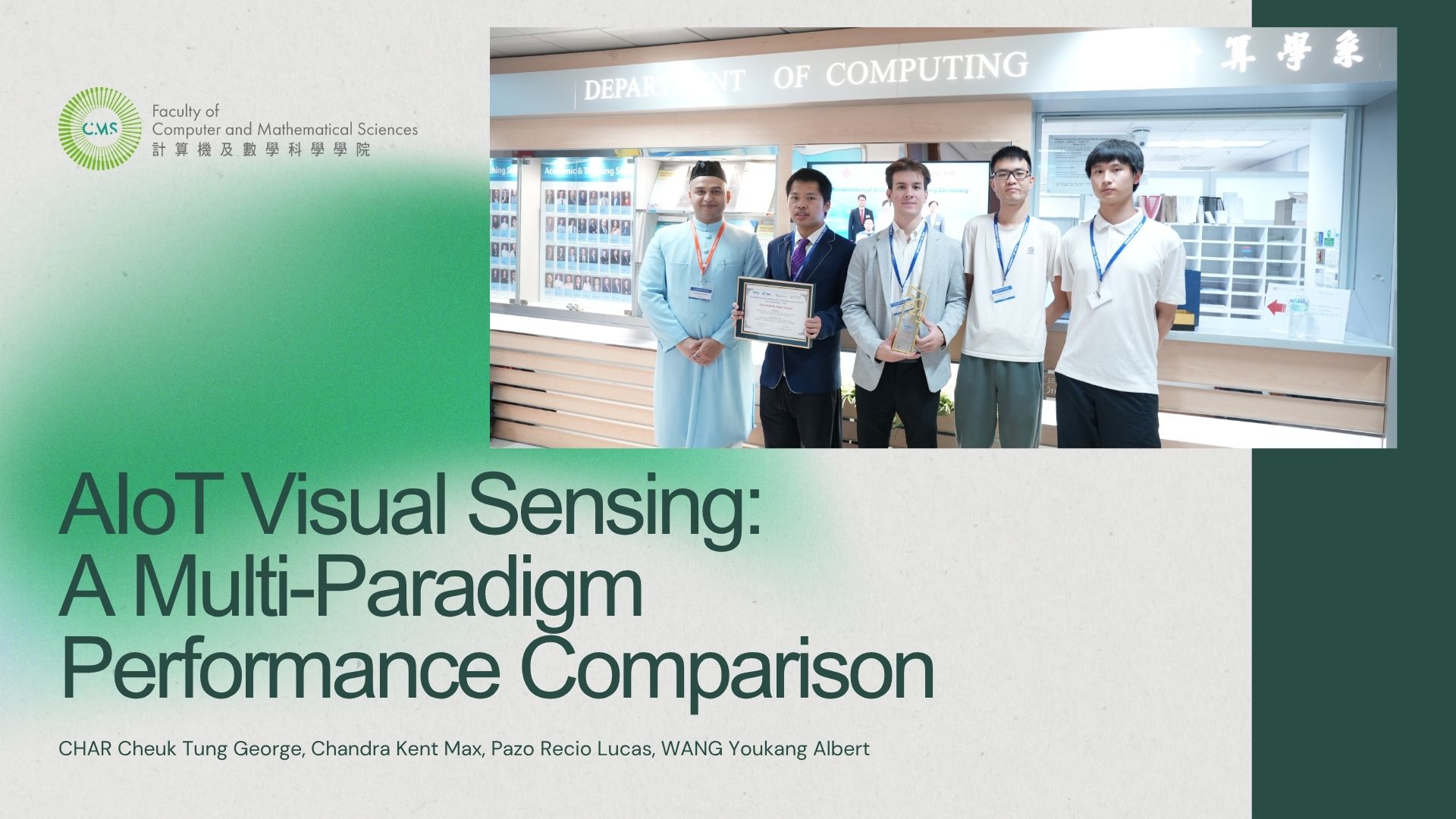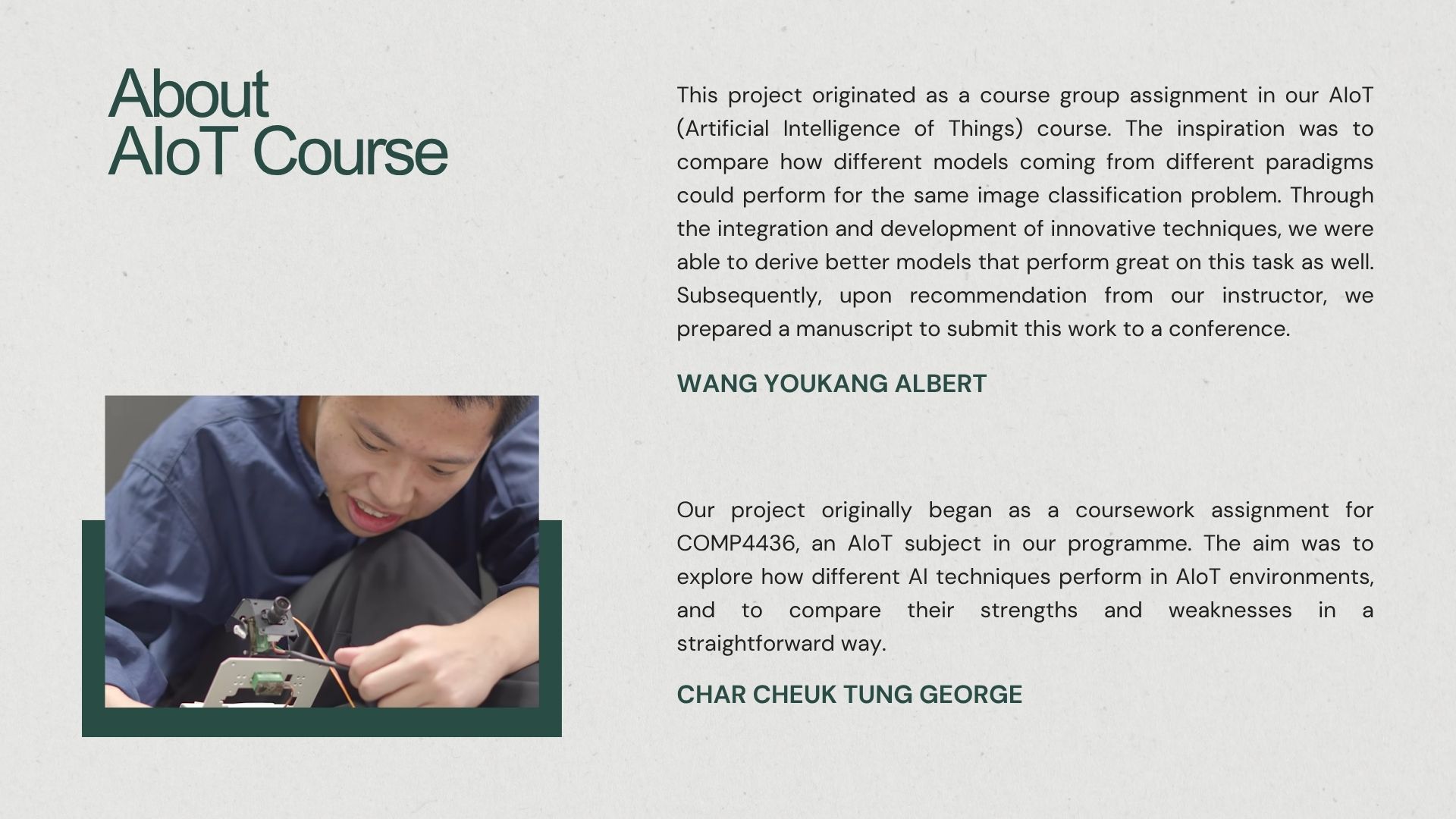



A team of interdisciplinary PolyU students—George, Kent, Lucas, and Albert—successfully transformed a standard AIoT coursework assignment into an award-winning research project. Their study focused on optimizing image classification for low-power IoT devices, exploring techniques like Spiking Neural Networks (SNN) and CNNs. By implementing transfer learning, the team overcame significant data limitations, boosting classification accuracy from a modest 60% to over 90%.
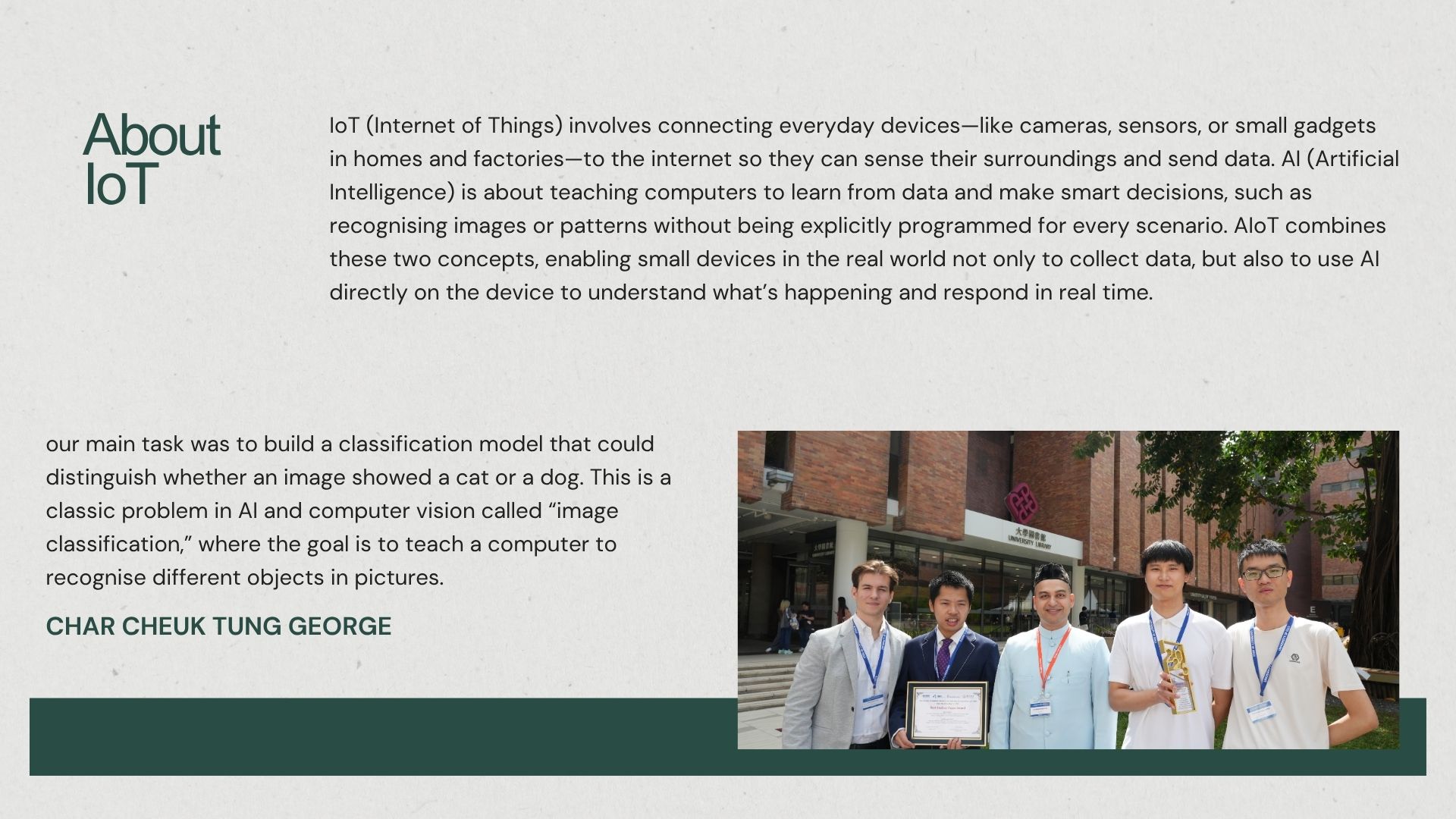
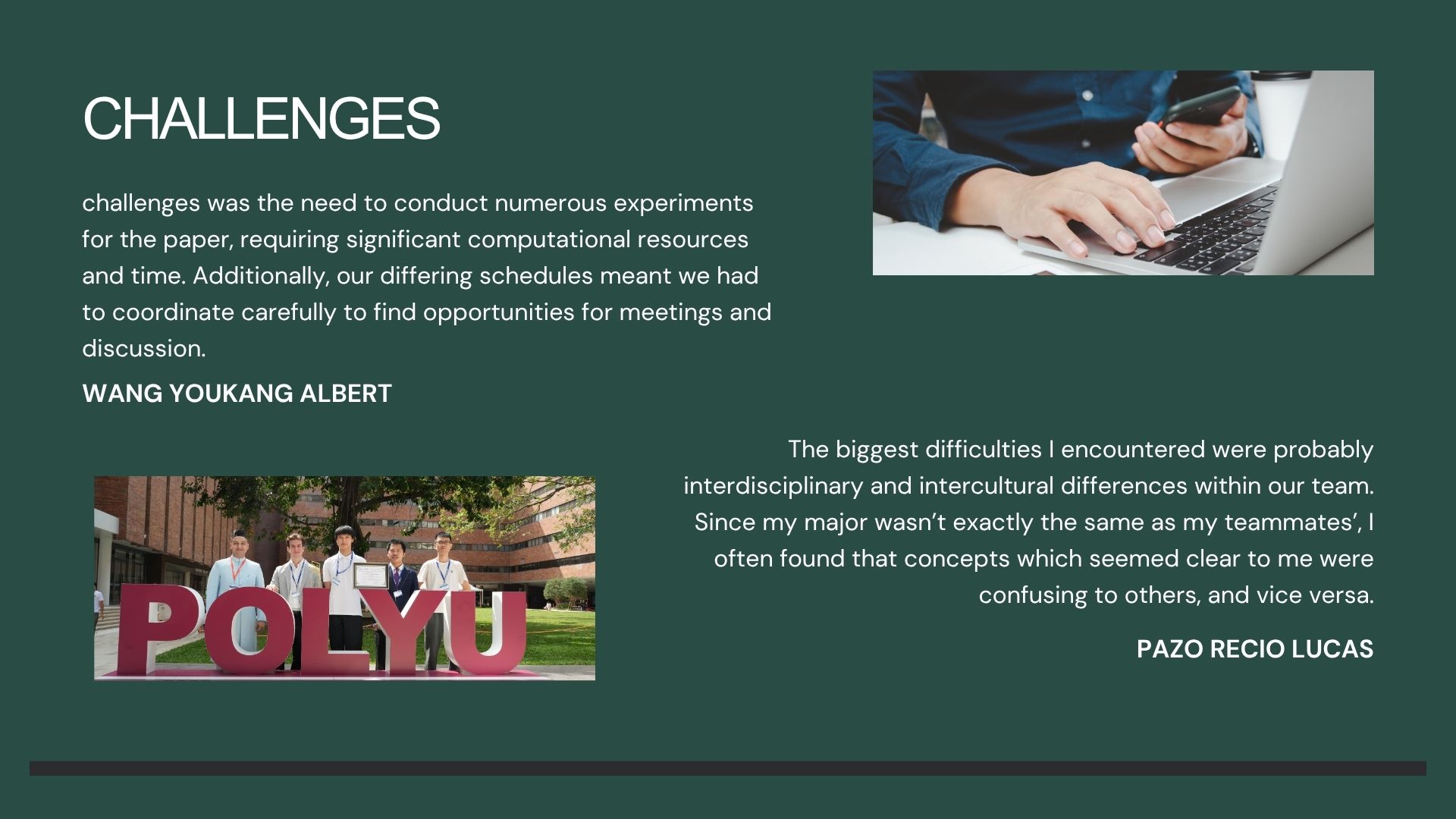
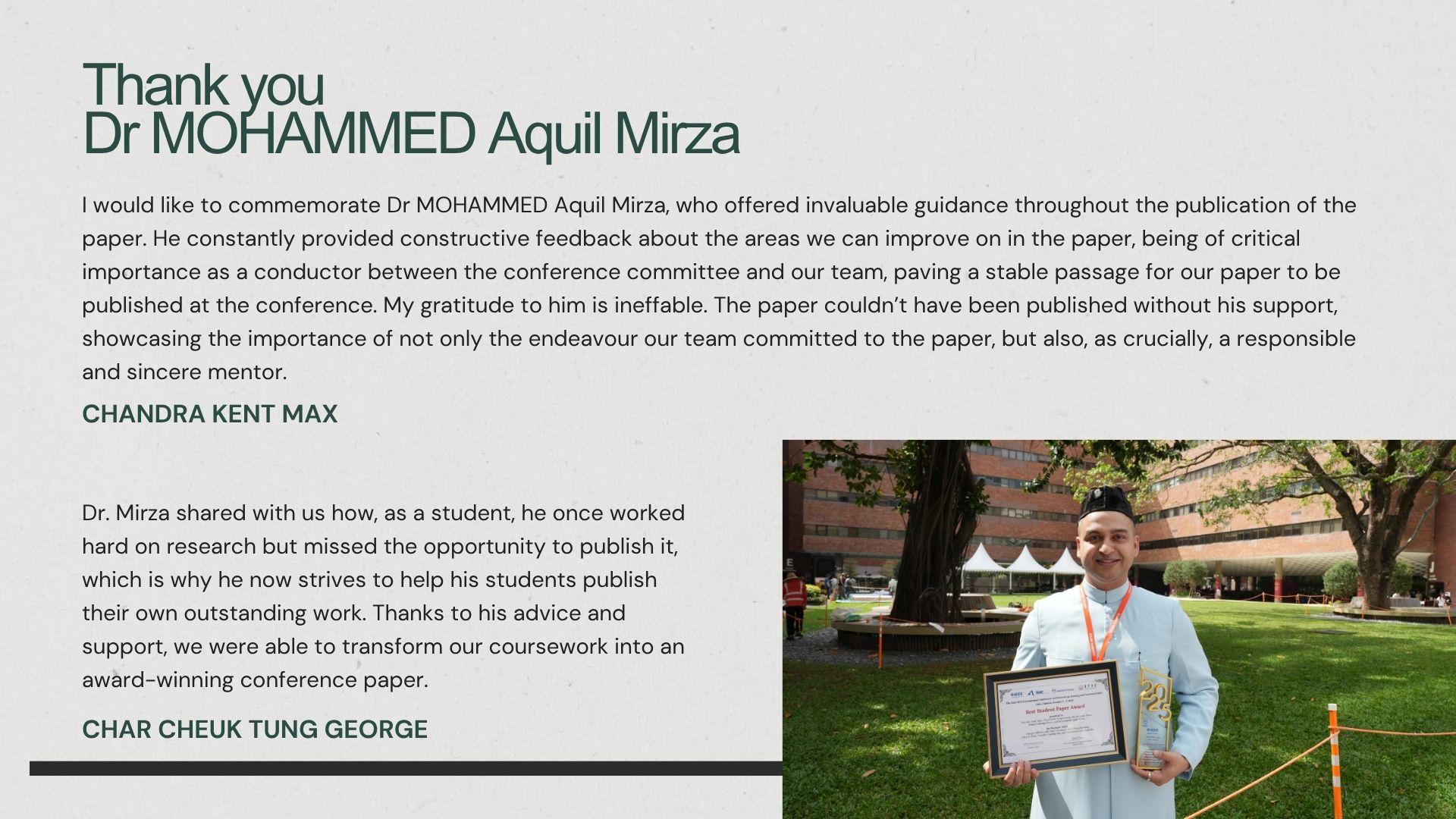
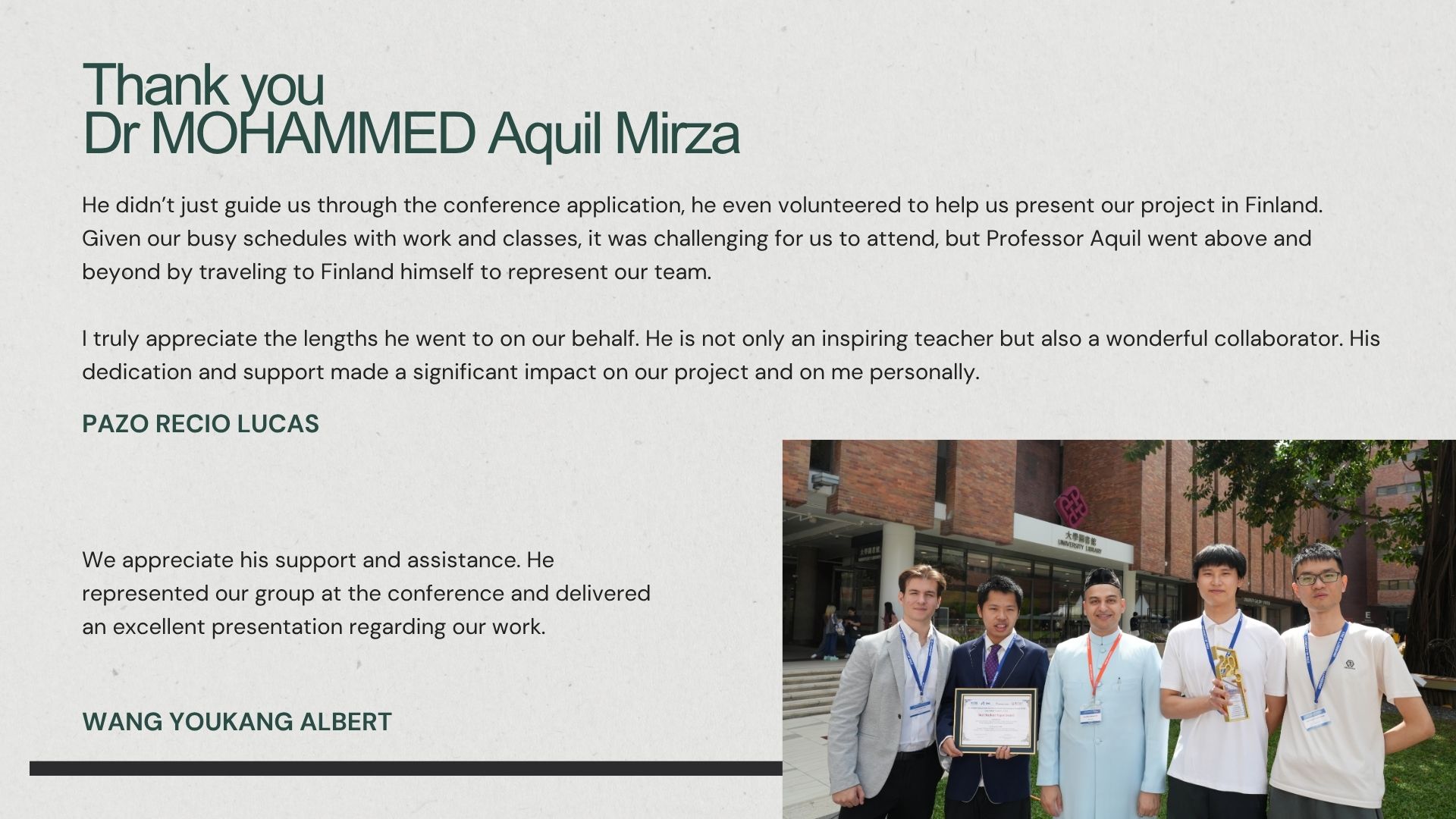
Under the mentorship of Dr. Mohammed Aquil Mirza, their findings were published and presented at the IEEE ICNSC conference, where they received the prestigious Best Student Paper Award. This project highlights the potential of energy-efficient AI in real-world applications like robotics and smart sensing, demonstrating how student collaboration and faculty support can turn academic challenges into impactful industry contributions.
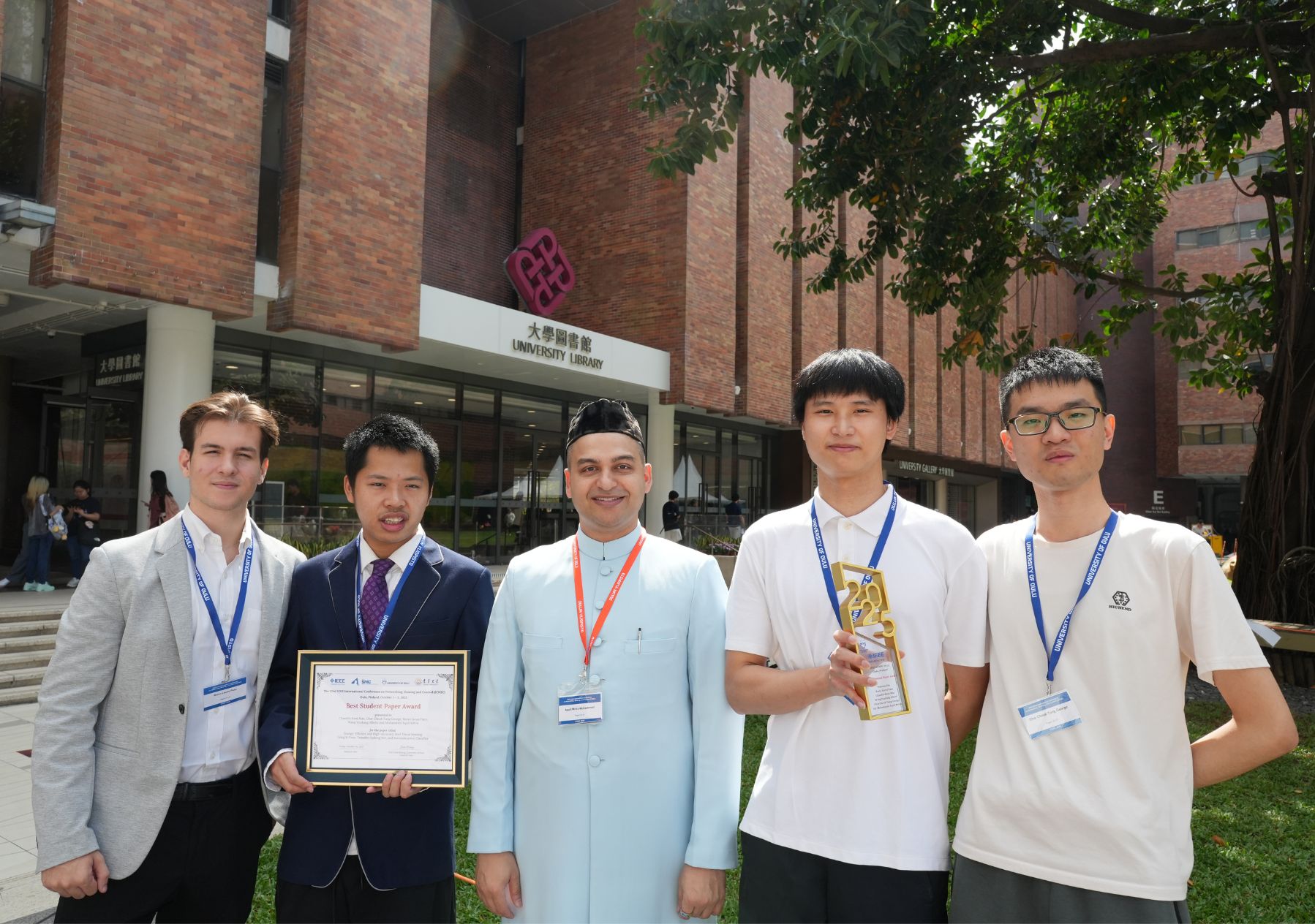
Mr. PAZO RECIO Lucas
Mr. WANG Youkang Albert
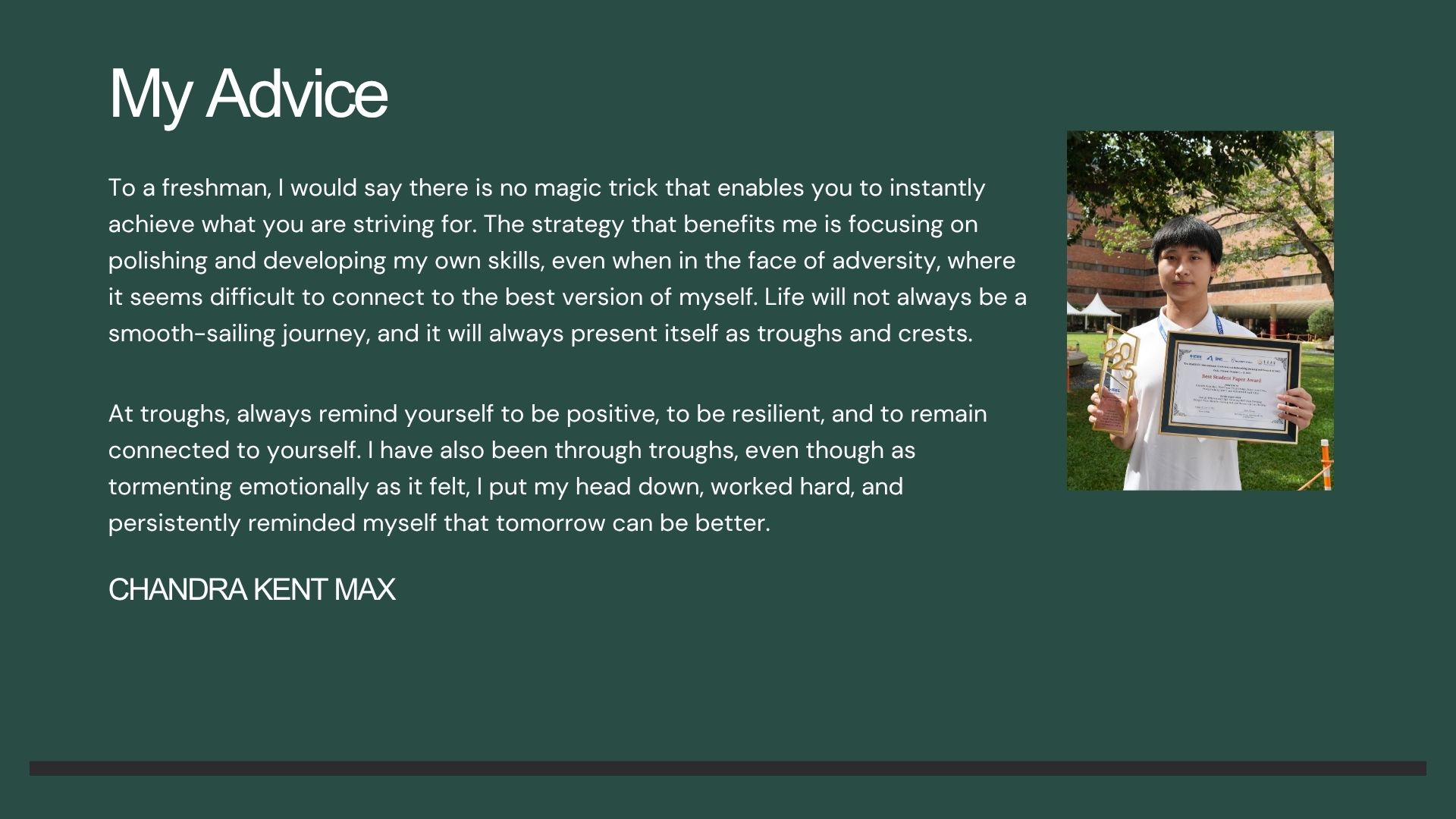
Mr. CHANDRA Kent Max
Mr. CHAR Cheuk Tung George
Faculty of Computer and Mathematical Sciences
Department of Computing
Spiking Neural Networks represent the "third generation" of artificial neural network architectures. Unlike traditional Artificial Neural Networks (ANNs) that use continuous, real-valued activation functions, SNNs communicate via discrete, temporal events called "spikes." Mathematically, they model biological neurons using differential equations (such as the Leaky Integrate-and-Fire model) to accumulate input signals over time until a threshold is reached.
In this project, SNNs were selected because of their extreme energy efficiency, which is highly suited for resource-constrained AIoT (Internet of Things) devices. The team leveraged SNNs to achieve a highly efficient image classification system. After optimizing their source code and resolving early performance bottlenecks, their energy-efficient SNN achieved an outstanding 99.7% prediction accuracy, proving that biologically-inspired computing can match or exceed traditional deep learning in edge-computing scenarios.
Transfer learning is a machine learning technique where a model developed for a source task (typically trained on a massive dataset like ImageNet) is repurposed as the starting point for a model on a target task. Mathematically, it leverages pre-learned feature extractors (like Gabor filters, edge detectors, and shape classifiers in early-to-middle layers) to combat the problem of data scarcity, which otherwise leads to overfitting and high variance when training deep architectures from scratch.
The students encountered a "performance plateau" around 70% accuracy when training their Convolutional Neural Networks (CNNs) from scratch because of their small dataset—simulating a real-world scenario where IoT devices can only gather limited data. By implementing transfer learning, they imported knowledge from highly generalized, pre-trained models. This mathematical shortcut allowed them to successfully bypass data scarcity constraints and dramatically boosted their image classification accuracy to over 90%.
Hyperparameters are the configuration settings of a machine learning model that are set prior to training (e.g., learning rate, batch size, optimization algorithms, and regularization factors). Unlike standard parameters (weights and biases), they are not learned during gradient descent. Optimizing hyperparameters is a mathematical search problem aimed at finding the global minimum of a highly non-convex loss landscape.
When the team’s initial models failed to exceed 60% accuracy, they systematically experimented with hyperpa rameter tuning. They adjusted training dynamics such as the learning rate (which dictates the step size taken toward a minimum during optimization) and batch size (which dictates gradient estimation variance). This rigorous scientific process helped them identify the mathematical limitations of their initial architecture and eventually concluded that data volume, rather than parameter tuning, was the primary bottleneck.
Training deep neural networks involves billions of high-dimensional matrix multiplications and tensor operations (linear algebra). Central Processing Units (CPUs) process tasks sequentially, whereas Graphics Processing Units (GPUs) feature highly parallel architectures. Frameworks like NVIDIA’s CUDA (Compute Unified Device Architecture) allow developers to utilize GPUs for general-purpose mathematical computations, executing thousands of arithmetic operations simultaneously.
To conduct the vast number of experiments required for a comparative research paper, the team required massive computational throughput. They utilized PolyU’s Student High Performance Computing (HPC) Services and computing labs, leveraging CUDA GPU support to accelerate their training cycles. Running parallel operations on GPUs allowed them to process complex CNN and SNN training matrices in a fraction of the time it would take on a standard personal computer.
Training deep neural networks involves billions of high-dimensional matrix multiplications and tensor operations (linear algebra). Central Processing Units (CPUs) process tasks sequentially, whereas Graphics Processing Units (GPUs) feature highly parallel architectures. Frameworks like NVIDIA’s CUDA (Compute Unified Device Architecture) allow developers to utilize GPUs for general-purpose mathematical computations, executing thousands of arithmetic operations simultaneously.
To conduct the vast number of experiments required for a comparative research paper, the team required massive computational throughput. They utilized PolyU’s Student High Performance Computing (HPC) Services and computing labs, leveraging CUDA GPU support to accelerate their training cycles. Running parallel operations on GPUs allowed them to process complex CNN and SNN training matrices in a fraction of the time it would take on a standard personal computer.
The students went far beyond the basic syllabus of their COMP4436 course by actively searching for external knowledge to solve complex technical problems.
When Max faced issues with his Spiking Neural Network (SNN) model scoring below 60% accuracy, he took the initiative to "scour through online websites, submerge in video tutorials, and scrutinize coding textbooks" to refine the methodology.
George noted that although transfer learning was only briefly introduced in class, the team took the initiative to "explore it further by reading online tutorials and studying practical examples."
They actively sought and incorporated the academic guidance of Dr. Mohammed Aquil Mirza, who served as a vital mentor, helping them structure their paper, address limitations, and navigate the conference submission process.
The project required the students to collaborate closely while navigating diverse academic backgrounds and logistical constraints.
Albert and Lucas highlighted the challenge of coordinating meeting schedules, particularly matching Lucas’s Spanish routine with his teammates' local Hong Kong schedules.
Lucas pointed out that because teammates had different academic majors, they had to work hard to bridge conceptual gaps. They succeeded by fostering an environment of mutual respect and open communication.
When the team hit a technical plateau, they utilized a highly collaborative approach. Max recalled that they "sat down and shared insights," analyzed each other's code, and brainstormed solutions collectively rather than working in isolation.
The students encountered multiple technical failures but treated them as iterative learning opportunities to refine their models.
Max’s initial models yielded a disappointing <60% accuracy. Instead of accepting this result, he analyzed his code, identified flaws, and systematically worked to bring the accuracy up to 70%.
When trying to improve their CNN models on a small dataset, George’s team initially tried tuning hyperparameters. When they realized this "wasn't enough" to solve the core data-limitation problem, they learned from this failed attempt and pivoted to a completely different strategy—transfer learning—which ultimately pushed their accuracy above 90% (and eventually 99.7% for the SNN).
The transition of this project from a classroom assignment to an award-winning IEEE conference paper heavily relied on upgrading their communication skills.
George described how they had to learn the meticulous art of academic writing, ensuring their paper had "the proper structure, clear figures, well-documented experiments, and accurate references" to meet international conference standards.
Albert learned how to create effective conference presentation slides by identifying "what matters most to the audience during such events."
Max noted that the project significantly improved his ability to "comfortably communicate ideas in a more AI-focused context," which led to swifter identification of problem areas and clearer reporting of findings within the team.
The students demonstrated high adaptability when transitioning from a controlled classroom environment to a rigorous, resource-constrained research scenario.
Because they were working on AIoT (Artificial Intelligence of Things) devices, they had to adapt their algorithms to perform under low-resource, low-power constraints. When physical computational limits became an issue, they adapted by utilizing PolyU's cloud-based High-Performance Computing Services to run their GPU-heavy training tasks remotely.
Lucas reflected on the value of "navigating the steps of preparing a manuscript [and] responding to feedback" from international conference peer-reviewers, showing an ability to adapt their research output based on external, rigorous critique.
The pursuit of knowledge is a lifelong journey! To further expand your knowledge and continue your personal and professional growth. Click and explore the following learning resources:
Research and Information Literacy
Project Management and Teamwork
Continuous Improvement and Learning from Mistakes