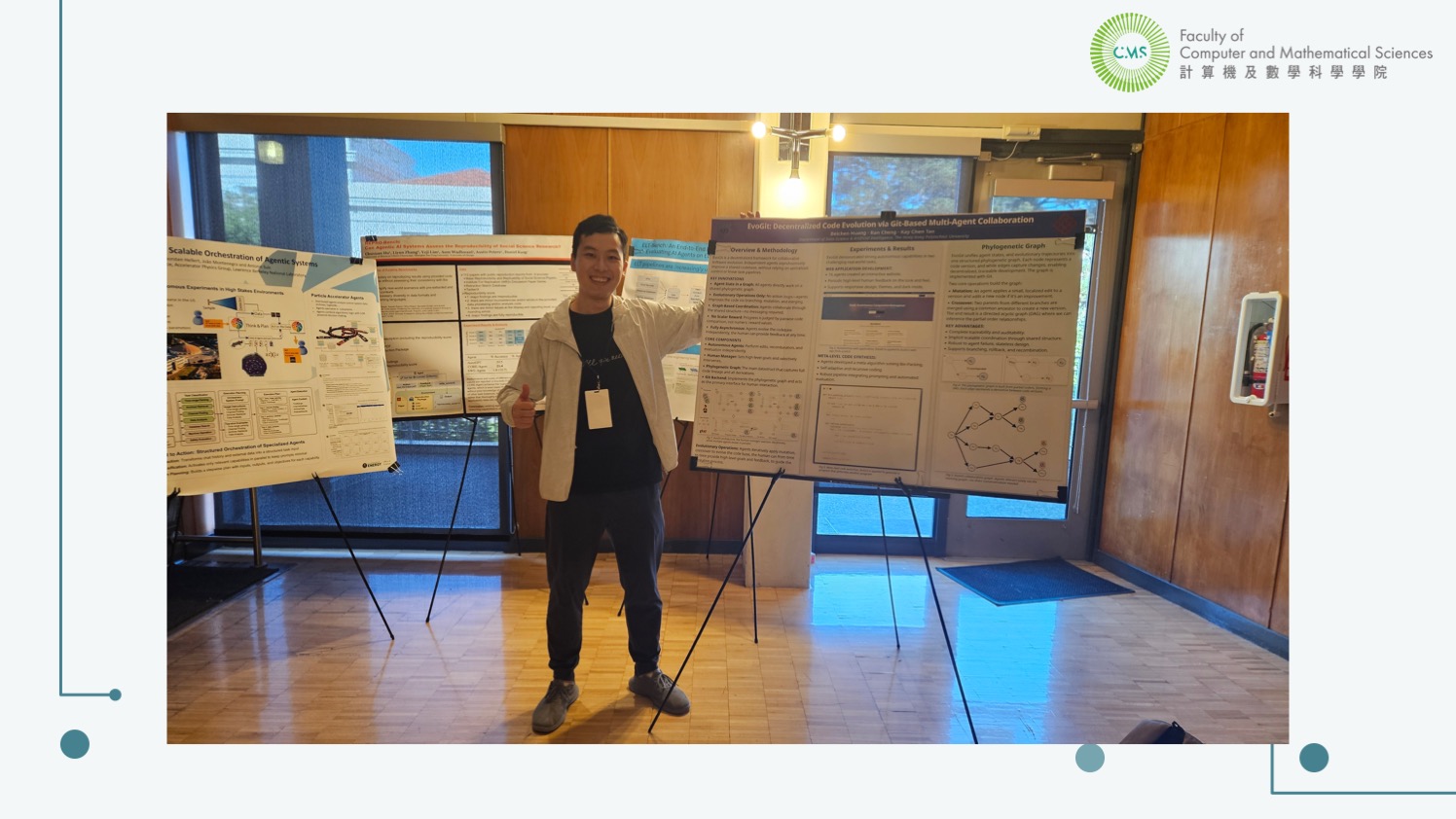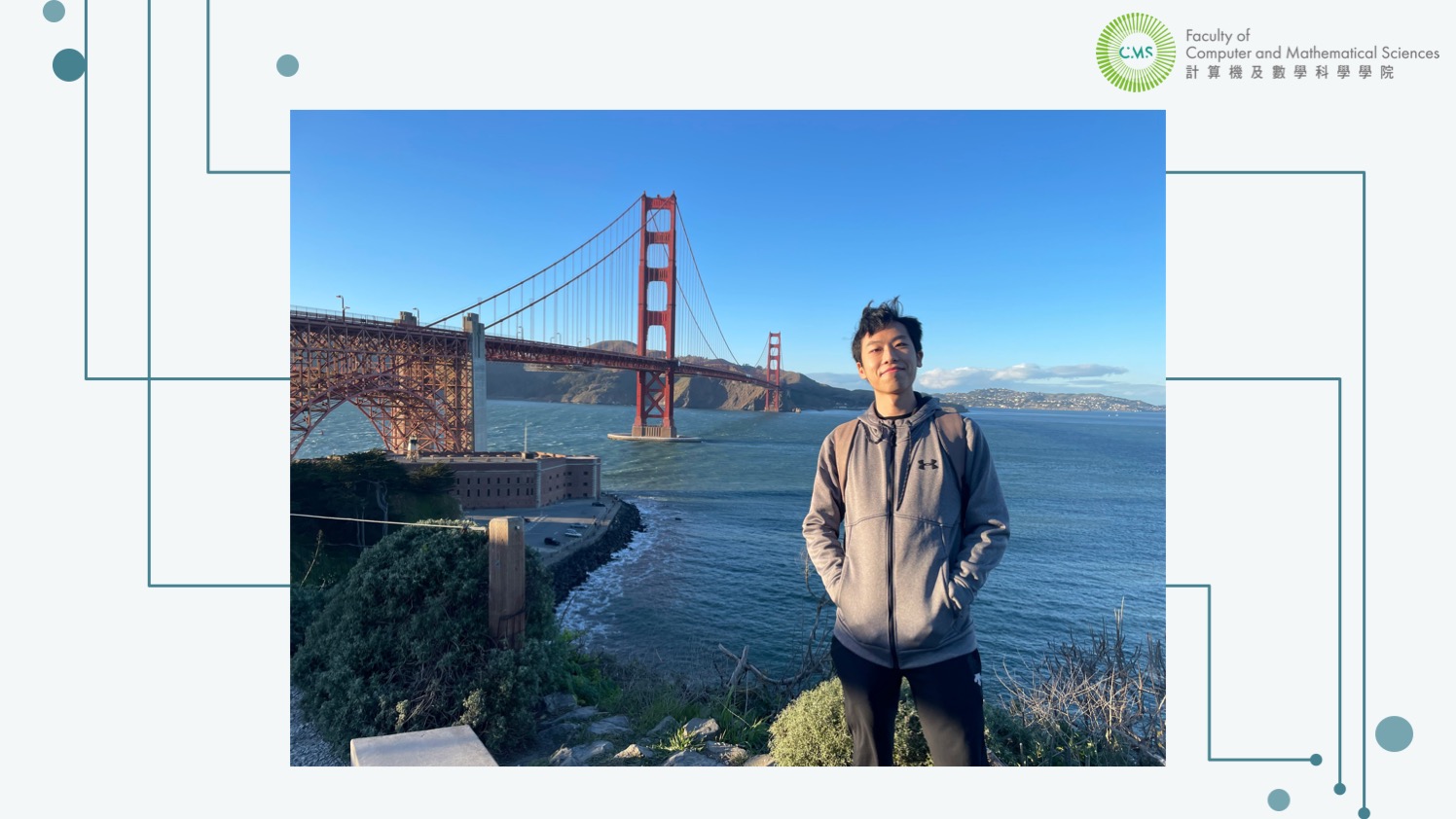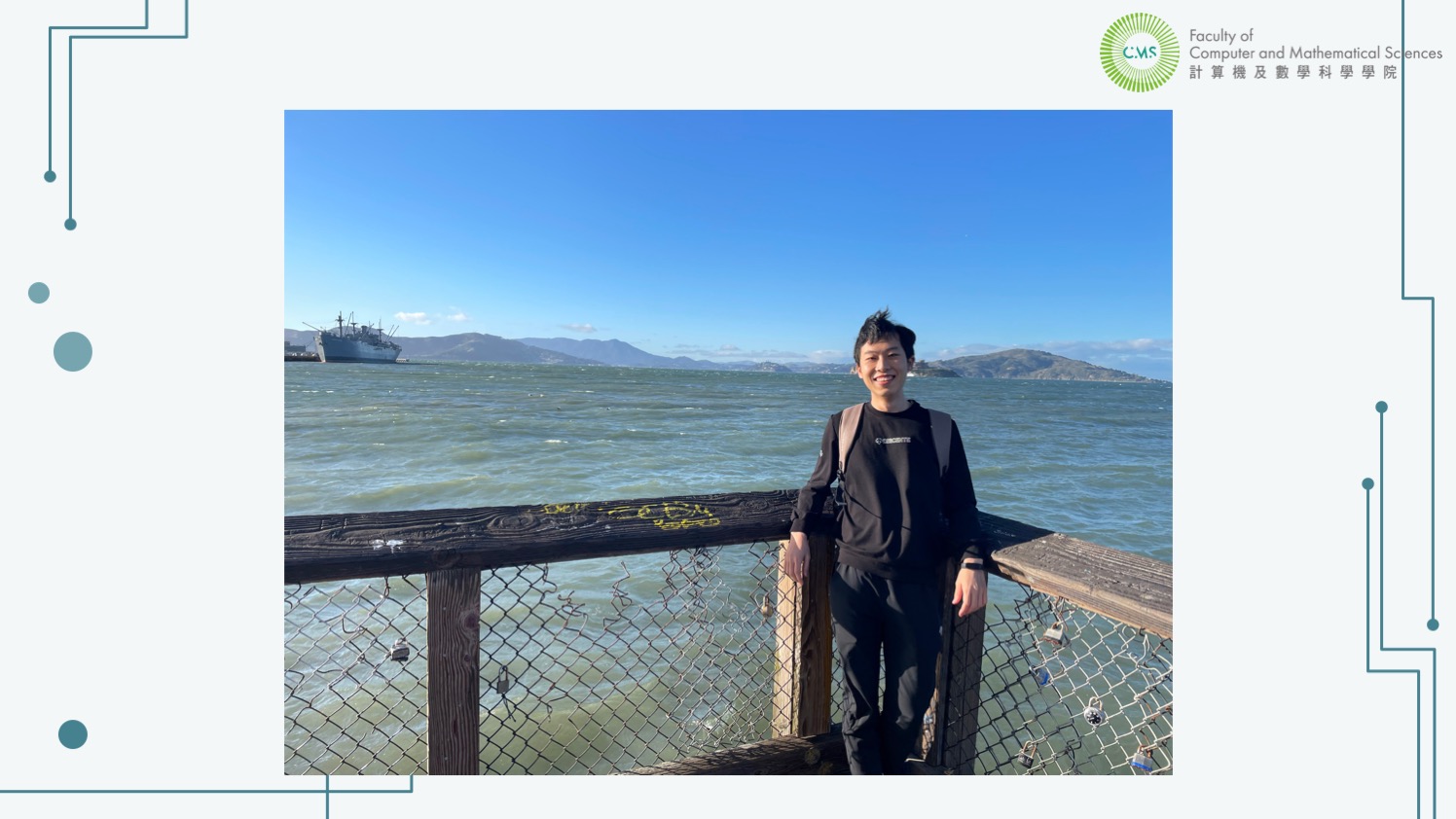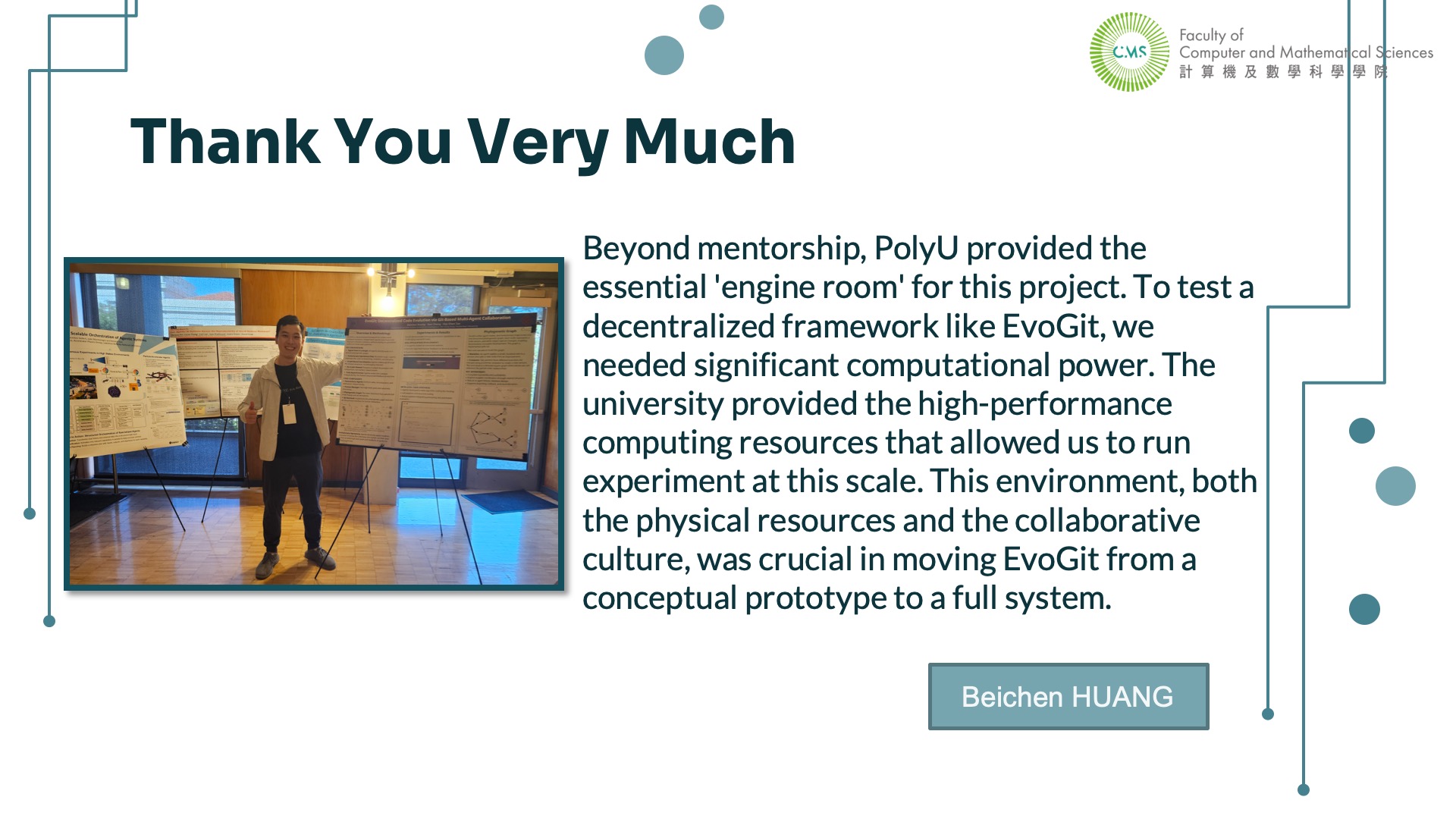



Beichen’s EvoGit is more than an award-winning research project; it is a tool creating real-world change. By treating code as an evolving organism, EvoGit uses decentralized agents to maintain and update software autonomously. After winning First Place at the AgentX Competition at UC Berkeley, Beichen immediately applied the framework to help his university, using it to automatically generate next-generation interactive slides for DSAI courses.
This "win-win" solution saves professors time while ensuring students have the most up-to-date resources. Through this process, Beichen mastered complex math and the art of patience. His work envisions a future where AI documentation and code stay in sync autonomously, proving that university-led research can scale into global solutions that benefit society as a whole.

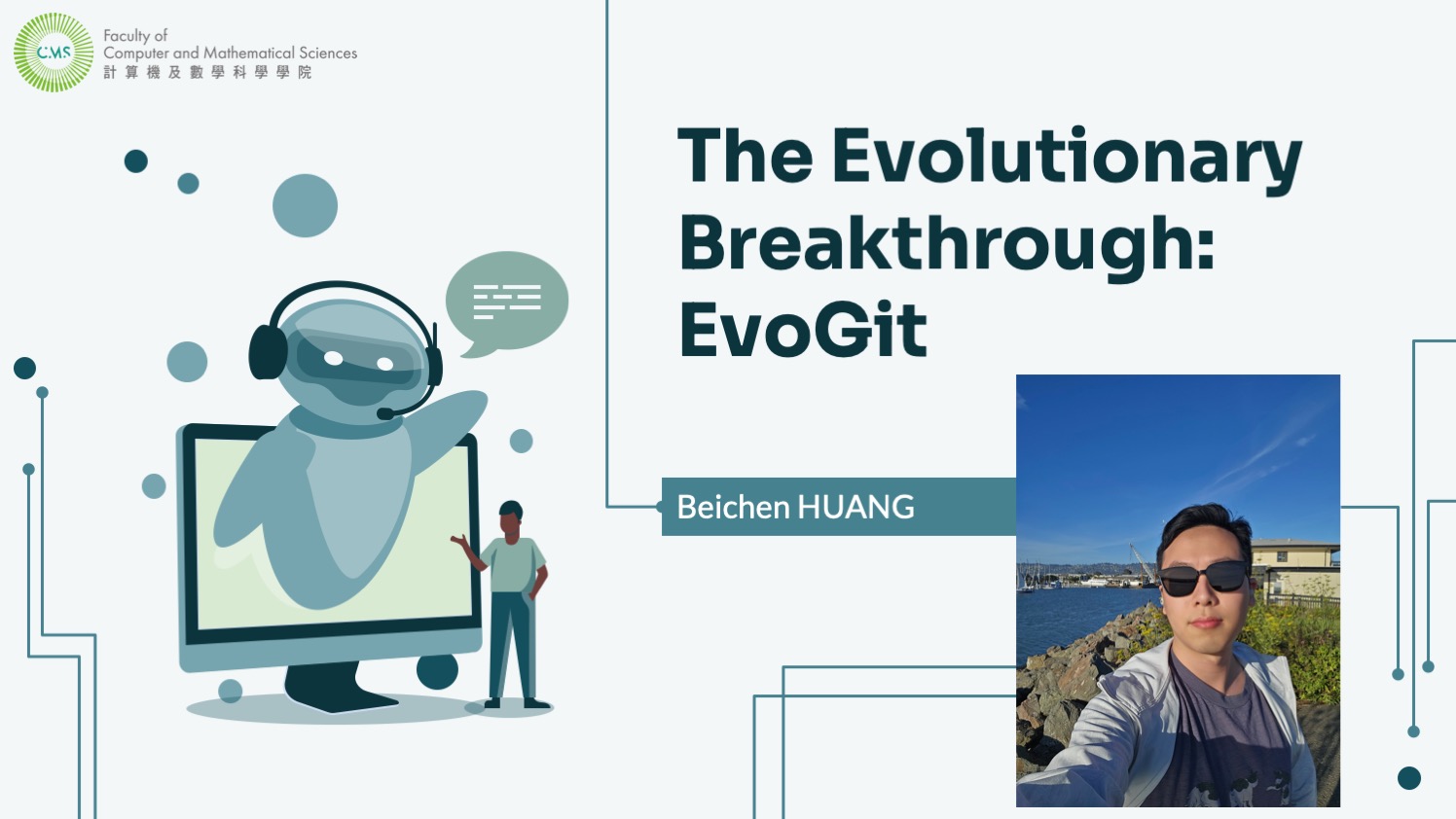
Mr. HUANG Beichen
Faculty of Computer and Mathematical Sciences
Department of Data Science and Artificial Intelligence
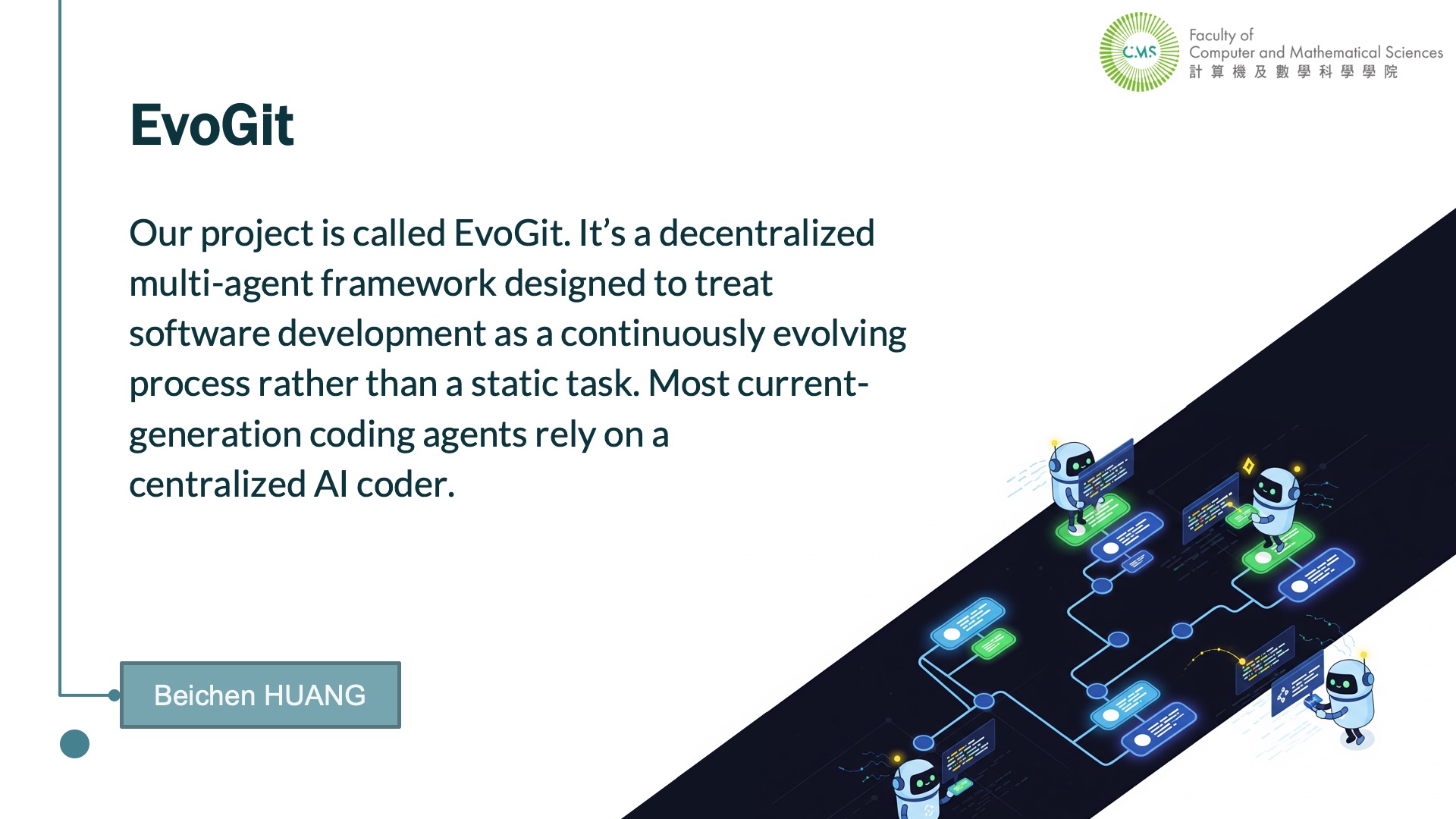
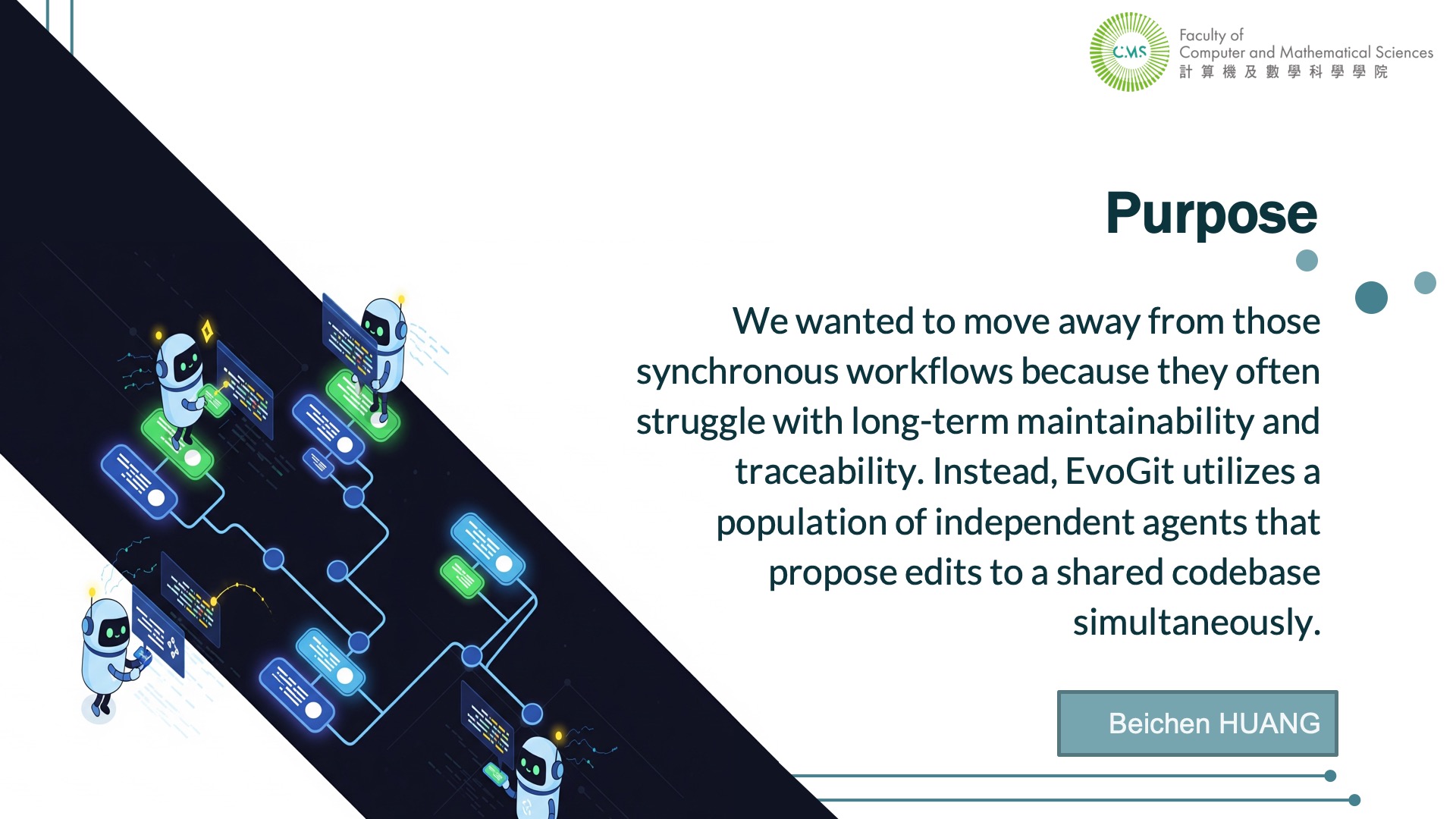
The core of EvoGit is a multi-agent framework that moves away from traditional, centralized AI coding. Instead of one AI controller, the system uses a population of independent agents that work on a codebase simultaneously. This requires advanced knowledge of agent coordination and communication protocols to ensure that multiple AI "coders" can propose changes without creating conflicts or "absolute chaos," mimicking a scalable, distributed human engineering team.
EvoGit is inspired by natural evolution, treating software development as a continuous process of mutation and selection. Beichen applied evolutionary principles to create a system where code is not a static product but an evolving organism. By utilizing a "population" of agents to propose decentralized changes, the framework allows for a more robust and complex codebase to emerge through autonomous, iterative refinement.
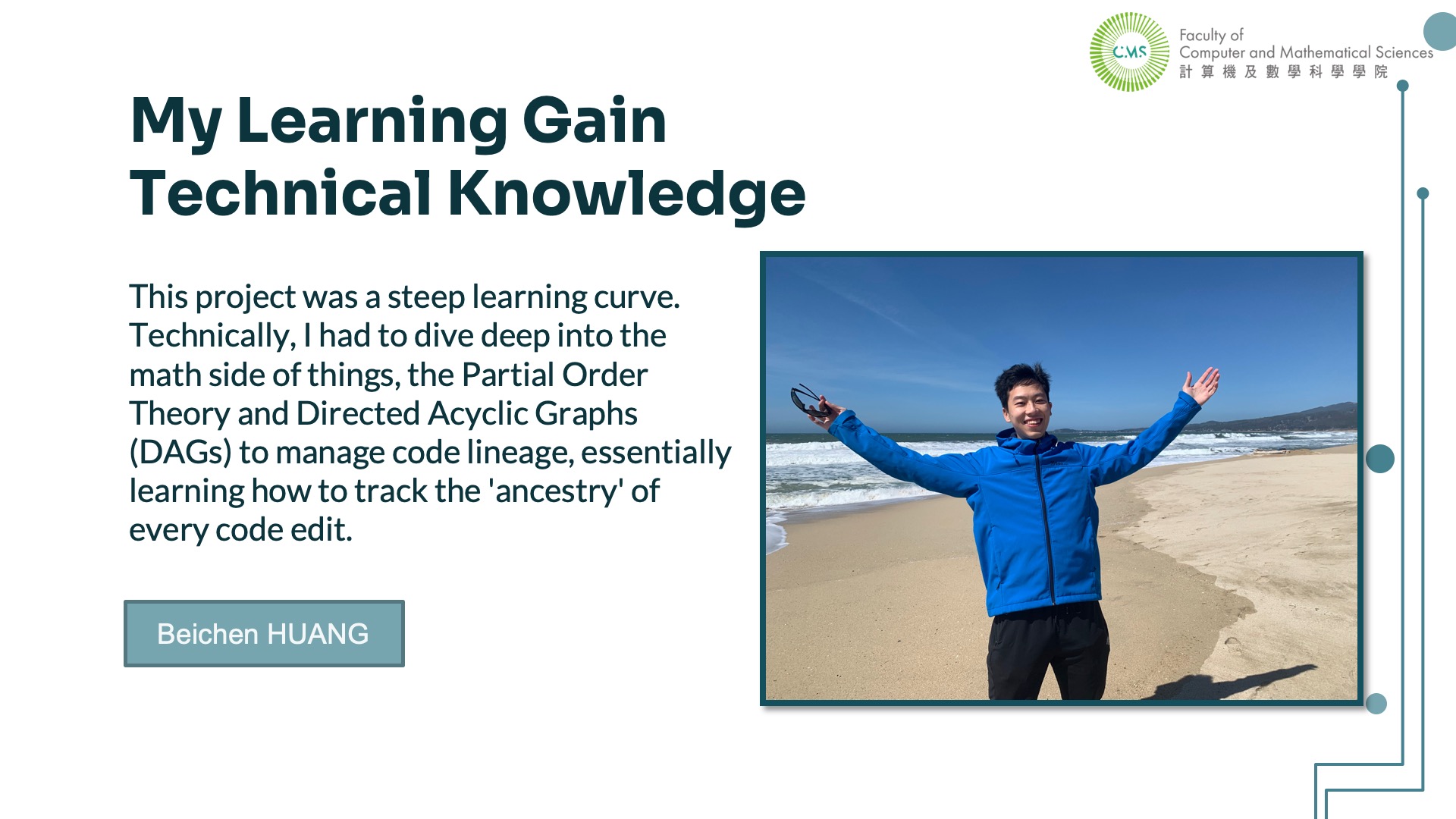
To manage the history and "ancestry" of code edits, Beichen utilized Directed Acyclic Graphs (DAGs). This mathematical structure is essential for tracking how different versions of code branch and merge over time. In the context of AI agents, DAGs provide the necessary traceability to understand which agent made which change and how those changes relate to the overall evolution of the software, similar to how Git tracks version history.
Beichen dived deep into Partial Order Theory to handle the mathematical complexity of code lineage and concurrency. In a decentralized system where agents work simultaneously, there is often no single "correct" sequence of events. Partial Order Theory provides the logic to determine which edits are dependent on others and which are independent, allowing the agents to "branch and merge" their work naturally within the phylogenetic graph.
EvoGit represents a significant advancement in Automated Software Engineering, where the goal is to create AI that can autonomously maintain and improve software. Beichen applied this to real-world scenarios, such as generating next-generation interactive slides for DSAI courses. This requires the AI to understand the logic of the codebase (or content) and refine it over time, ensuring documentation and code remain perfectly in sync without human intervention.
Beichen’s core contribution—designing EvoGit as a decentralized, evolving multi‑agent framework instead of a single centralized coder—shows strong innovation. He challenged the dominant paradigm (single-agent coding systems), blended concepts from AI and natural evolution, and invented the Git-based phylogenetic graph to coordinate agents. This is creativity applied to a real, complex problem, not just an incremental tweak.
The main obstacle was not implementation but conceptual uncertainty: how to coordinate many independent agents on one shared codebase without chaos. Beichen analyzed the true bottleneck (coordination, not just performance), explored different abstractions, and eventually reframed the problem in terms of partial order theory, DAGs, and lineage tracking. The move from “we have many agents” to “we need a phylogenetic graph to structure their edits” is a deep example of analytical thinking and structured problem-solving.
To make EvoGit work, Beichen had to “dive deep into the math side of things”—partial order theory, directed acyclic graphs, code ancestry. These were not just course topics but tools he actively sought out and learned to solve his own research problem. This shows he can identify knowledge gaps, independently acquire advanced theoretical tools, and integrate them into a novel system—an essential lifelong skill for adapting to new domains.
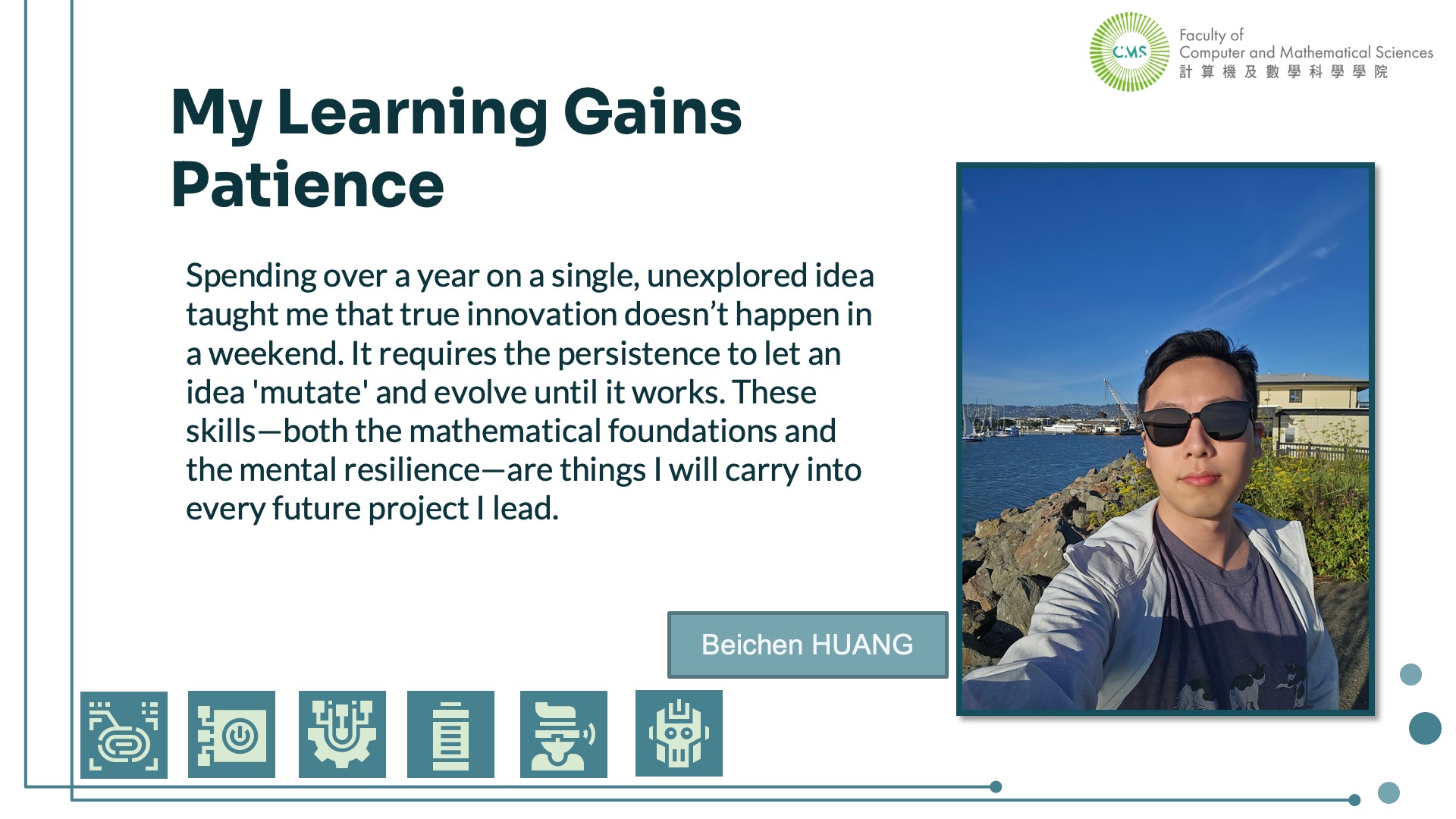
Beichen describes spending over a year in “intellectual limbo,” with no clear progress and no roadmap. Instead of abandoning the idea, he continued iterating, testing, and refining hypotheses until the Git-based phylogenetic graph emerged as the key. He explicitly connects this to a lasting lesson: that “true innovation doesn’t happen in a weekend” and that breakthroughs often lie just beyond sustained effort. This mindset of persistence and iterative improvement is central to lifelong learning.
EvoGit was not left as a competition prototype. Beichen adapted the framework to a new context: automatically evolving course slides for DSAI classes. He recognized that “slide content as code” could be updated autonomously, saving professors time and providing students with dynamic materials. He also sees broader implications for automated software engineering and documentation in industry. This shows adaptability (applying the same core idea to different domains) and strategic planning (thinking beyond a single project toward long-term, scalable impact).
The pursuit of knowledge is a lifelong journey! To further expand your knowledge and continue your personal and professional growth. Click and explore the following learning resources:
Decentralized Multi-Agent System
Automated Software Engineering
Critical Thinking and Problem-solving